

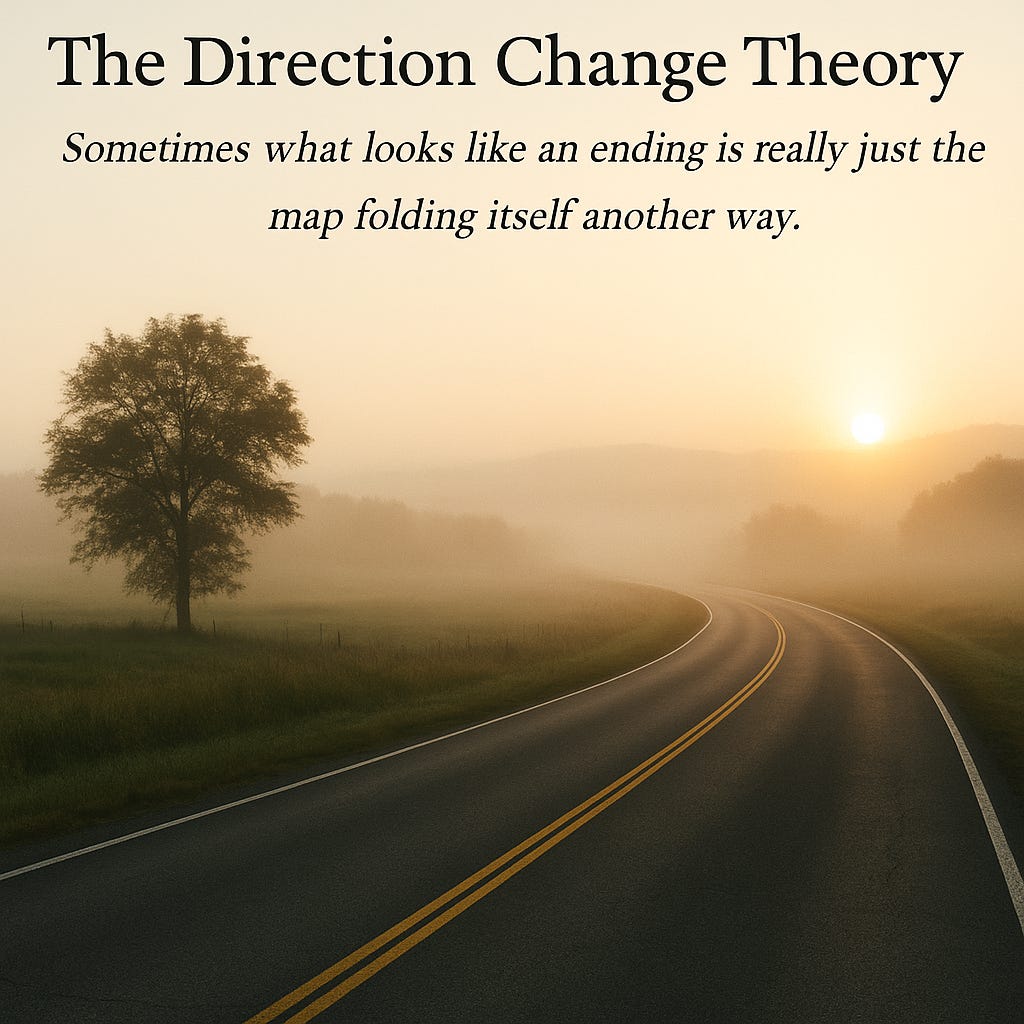
Sometimes what looks like an ending is really just the map folding itself another way.
There’s this girl I work with. Sabrina. Mid-20s, smart, kind, bubbly. Just bought a house. She’s worried she’s going to lose her job. Really worried — the kind of worried that still believes effort might be enough.
She hasn’t been through it yet.
Hasn’t walked through that door.
The door where you realize it’s not just a setback. It’s a reroute.
I didn’t know how to tell her that. How do you explain the moment when the bottom drops out — the accident, the layoff, the diagnosis, the betrayal — and you realize there’s no way back to how it was?
How do you tell someone who’s still standing on the safe side of the door what it feels like to cross through?
You can’t. Not really. You just watch them brace themselves against a storm you already know is coming, and hope they’ll make it through.
What I told her, though, was this:
Paul used to say, “Whenever I thought I was being rejected from something good, I was actually being redirected to something better.”
Not instantly. Not cleanly. Not in the way a motivational poster would promise.
But eventually.
Because sometimes, when it all goes sideways — the betrayal, the heartbreak, the job you gave years of your life to — it isn’t punishment.
It’s a direction change.
Call it God. Call it fate. Call it chaos with a side of grace.
To me, it has always felt like something bigger whispering:
“There’s no more road here. You need to go another way.”
And yeah, the detour sucks.
You cry in your car.
You scream at the universe.
You wonder if you’ll ever stop being angry, or if this pit in your stomach is now just… you.
But later — months, sometimes years later — you look back and see what you couldn’t from the edge. You see the map that wasn’t visible when all you could see was the wreckage.
It didn’t ruin you.
It rerouted you.
I used to think grit was just a slogan until a professor said it to me in a math class I was about to drop. I was working full-time at LOA, later at CA, and the formulas made no sense.
“Take a breath and gather up some grit,” he told me.
I did — and I passed, somehow with an A.
That lesson has followed me through every reroute since:
you don’t have to know the whole map, just keep showing up to learn the next equation.
I didn’t tell Sabrina all of this. I couldn’t.
But one day she’ll understand.
You don’t get to choose the moment when the road disappears.
But you do get to keep walking.
It's all about how you accept the change and what you do with it. Great post!
beautiful!!