

There’s a particular kind of dislike that sneaks up slowly, the way a bad smell does, until one day you realize you’re holding your breath every time you step outside. That’s how it was with my neighbor — let’s call him Ahole — and his wife, Big J. We were friendly at first. That’s the trap. Ahole was a chiropractor in New York City, outwardly generous, seemingly easygoing, the kind of man who offered help in a way that felt neighborly until you realized the help came with an invoice you didn’t see coming. He wanted to write off expenses for his second house, so he suggested adjusting us for whatever our insurance paid. It sounded reasonable. It sounded generous. It wasn’t.
In the winter we barely saw them, but Ahole never fully disappeared. He’d text, casually, about how we should really come into his office in the city, how lapses in treatment were “problematic,” how insurance companies needed continuity and justification. Suddenly there was talk of X-rays we didn’t need, urgency that didn’t exist, all so he could keep billing through the winter and maintain the fiction that the house next door was a place of business. It was never framed that way, of course. It was framed as concern… professionalism… doing us a favor.
He volunteered his services at beach volleyball tournaments too — hands everywhere, goodwill on tap — funneling people back to his house for adjustments. They didn’t have insurance, so I assume their co-pays looked a lot like ours eventually did: a handle of Tito’s, a case of beer. Ours, for the record, were officially fifteen dollars. Unofficially they ran closer to thirty, plus garbage cans, mail pickup, house watching, snow shoveling, sidewalk clearing, and — in the early days — even lawn mowing before we finally hired a service. The favors didn’t replace the co-pays. They stacked on top of them.
Big J was a study in contrast. She slept late — ten, eleven — while Ahole was up at the ass crack of dawn, claiming he couldn’t do anything until she was awake. She handled the weeding and gardening, a devoted tree hugger in both ideology and practice. Getting out the door took over an hour, every time: hair, makeup, the whole ceremony. Nature mattered deeply to her, as long as it stayed curated
.
Their side yard had an old fountain that never worked. Ahole talked about fixing it the way some people talk about quitting drinking or learning Italian — always one day.
Ahole’s superiority complex didn’t stop at chiropractic care. It bled into everything physical, everything communal — especially volleyball and mountain biking, the arenas where he liked to position himself as benevolent gatekeeper. He talked constantly about “levels,” about who was serious and who was just messing around, about form and fundamentals and how most people never really learned them properly. When Gino, John, and Patrick played what he called “crappy volleyball,” he’d say he might include them sometime — include being the operative word — as if participation were something he could grant or withhold. It was always framed as generosity. It always landed like judgment.
Mountain biking was the same. He spoke about trails the way some people talk about private clubs, dropping names and difficulty ratings, casually reminding everyone how long he’d been doing it, how much better his gear was, how most people didn’t really understand the sport. He never said outright that he was better than everyone else. He didn’t have to. It was embedded in the way he explained things no one asked him to explain, corrected people mid-sentence, and offered advice that felt less like help and more like a reminder of hierarchy.
Mountain biking finally cracked the façade. One time John actually went with him — a real outing, not one of Ahole’s theoretical superiority lectures — and Ahole fell. Twice. Couldn’t keep up. The terrain didn’t care about his gear, his experience, or the way he liked to narrate himself as an authority. John came back amused more than anything, quietly processing the mismatch between the man who talked endlessly about skill and the man who couldn’t stay upright. Later, deadpan, John said maybe they should do some crappy mountain biking next time so Ahole wouldn’t fall. It wasn’t mean. It was observational. And it landed because it reversed the hierarchy Ahole worked so hard to maintain.
What made it worse was that this condescension was inconsistent — selective. He could be charming, expansive, even fun, right up until the moment someone failed to meet whatever internal standard he’d decided to apply that day. Then the warmth disappeared. The tone shifted. You were either being managed, corrected, or quietly excluded. It took a while to realize that the friendliness wasn’t a baseline — it was conditional.
That’s the thing about people like that: they don’t dominate through overt cruelty. They do it through access. Through approval. Through the constant suggestion that proximity to them is a favor.
The breaking point came over a tree. A weed tree, really — something that sprouted from an acorn or a seed and never belonged where it landed. It sat on our side of the property line, unhealthy, buggy, dropping leaves into our yard and shading our driveway in ways we didn’t want. One winter, Patrick’s brother was visiting and offered to take it down. We probably should have asked first. Instead, we texted to let them know. They sent laughing emojis. I think they thought we were joking.
We weren’t.
The next time they came down, it all exploded. Ahole yelled at Patrick, furious, insisting he had no right. Big J — normally slow-moving, measured — looked like she was about to burst an artery. Kara and John were there, witnesses to the whole thing, and John, bless him, said, “Your house looks so much better without that ugly tree.” Big J snapped back, full volume: “SHUT UP, JOHN.”
That was the beginning of the end.
Eventually we slid into avoidance. Not dramatic, just polite hellos if we happened to be outside at the same time. Then even that felt like work. We changed the Wi-Fi password too — no announcement, no confrontation — just quietly cut off the freeloading. It felt symbolic. Small. Necessary.
Once, after a particularly significant snowfall, we didn’t shovel his sidewalk. Patrick had hurt his back — the irony was not lost on anyone — and his chiropractor neighbor was, unsurprisingly, unavailable. When Patrick ran into him later, Ahole said, completely straight-faced, “What, did I forget a copay or something?” He wasn’t joking. He eventually asked the other neighbors — both in their seventies — if they would shovel for him so he wouldn’t get a ticket. Watching that happen was the moment any lingering obligation evaporated.
After that, we stopped pretending. No hellos. No eye contact. Just parallel lives on the same block. Patrick, however, still wouldn’t let me park in front of their house, which somehow made the whole thing worse. We were estranged, not at war — but he still obeyed the imaginary rules.
While we were away once, Ahole told our dog walker that our dog barked a lot. She looked at him and said, deadpan, “Yes. Dogs bark.” End of conversation. I loved her for that.
We saw them coming and going but never spoke. And then one day, without consciously deciding to notice, we realized we hadn’t seen Big J in a long time. Sometimes Ahole had her car. But she was gone. Weeks passed. Then months. Then maybe a year. Instead, a different woman started showing up — different car, staying over.
Big J, who used to talk endlessly about how swans mate for life, had vanished.
We started joking, because what else do you do, that he’d killed her and buried her in the backyard of his other house. It was just one of those ridiculous theories my brain creates when something feels off and no one can provide real information. But the absence lingered. No Big J. No gardening rituals. No hour-long hair-and-makeup exits. Just an empty space where a person used to be, and a man next door who behaved as if nothing at all had changed.
Eventually I asked the seventy-year-old neighbors where Big J was. This was after weeks of Googling her name and scrolling obituaries late at night, half expecting to find proof and half hoping not to.
They told me she had died. An apparent heart attack.
That was the phrase. Apparent.
There was no obituary. No notice. No public marker that she had existed at all. Which felt on brand. Ahole, being Ahole, hadn’t paid for one.
There was no service that we knew of. No flowers. No cars lining the street. Just absence, confirmed.
A woman who once took an hour to get ready to leave the house vanished without leaving so much as a paragraph behind.
I didn’t know what to feel — relief, guilt, discomfort, some mix of all three. The jokes we’d made stopped being funny retroactively. Whatever else she had been — rigid, sanctimonious, exhausting — she was still a person. And now she was gone.
What stayed with me wasn’t grief exactly. It was the strangeness of how easily someone can disappear when the person left behind controls the narrative — or chooses not to tell one at all.
What unsettled me most wasn’t just how completely Big J vanished. It was how quickly she was replaced.
Not emotionally — practically.
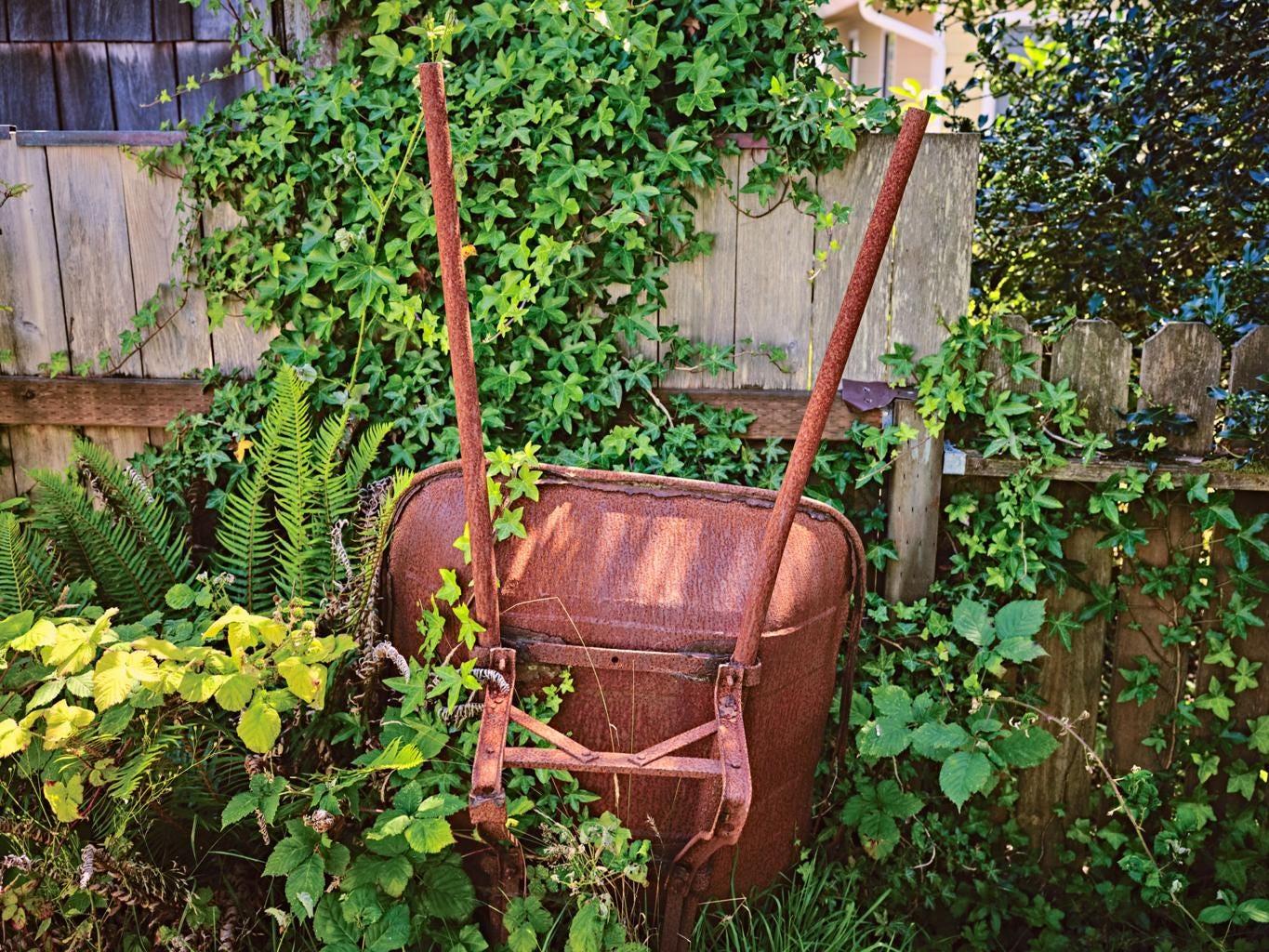
Another woman appeared, then stayed. She drove a different car. She occupied the same spaces. Eventually she was in the garden pushing Big J’s wheelbarrow, possibly wearing her work gloves. I even saw him teaching the new woman to ride a bike once. She looked terrified.
Big J had always handled the weeding and planting, her quiet domain, the thing she cared about most. And now he was out there instructing someone new, as if the role itself mattered more than the person who had once filled it.
The continuity was seamless. Too seamless.
It wasn’t grief I saw.
It was logistics.
I didn’t think he was mourning. I thought he was managing.
And sometime around that same period, the old fountain in their side yard disappeared.
He dismantled it quietly — no announcement, no ceremony — and either got rid of it or moved it to his other house. I didn’t see where it went. I only noticed that it was gone. The side yard looked cleaner. Emptier.
Only later did it occur to me that things that no longer served him had a way of quietly vanishing..
This is so quietly chilling.
The way you move from small exploitations and social hierarchies to her total erasure makes the last section land like a gut punch it stops being a quirky neighbor story and turns into a meditation on how easy it is to disappear when someone else controls whether your story gets told at all.
The image of another woman in Big J’s gloves, and the fountain vanishing like she did, is going to sit with me for a long time.
This is serial material
This is a creepy story!! But reappear good!! Its also relatable as heck!!