
Chapter 7: The Plot
Part One: You Seriously Don't Want to Know

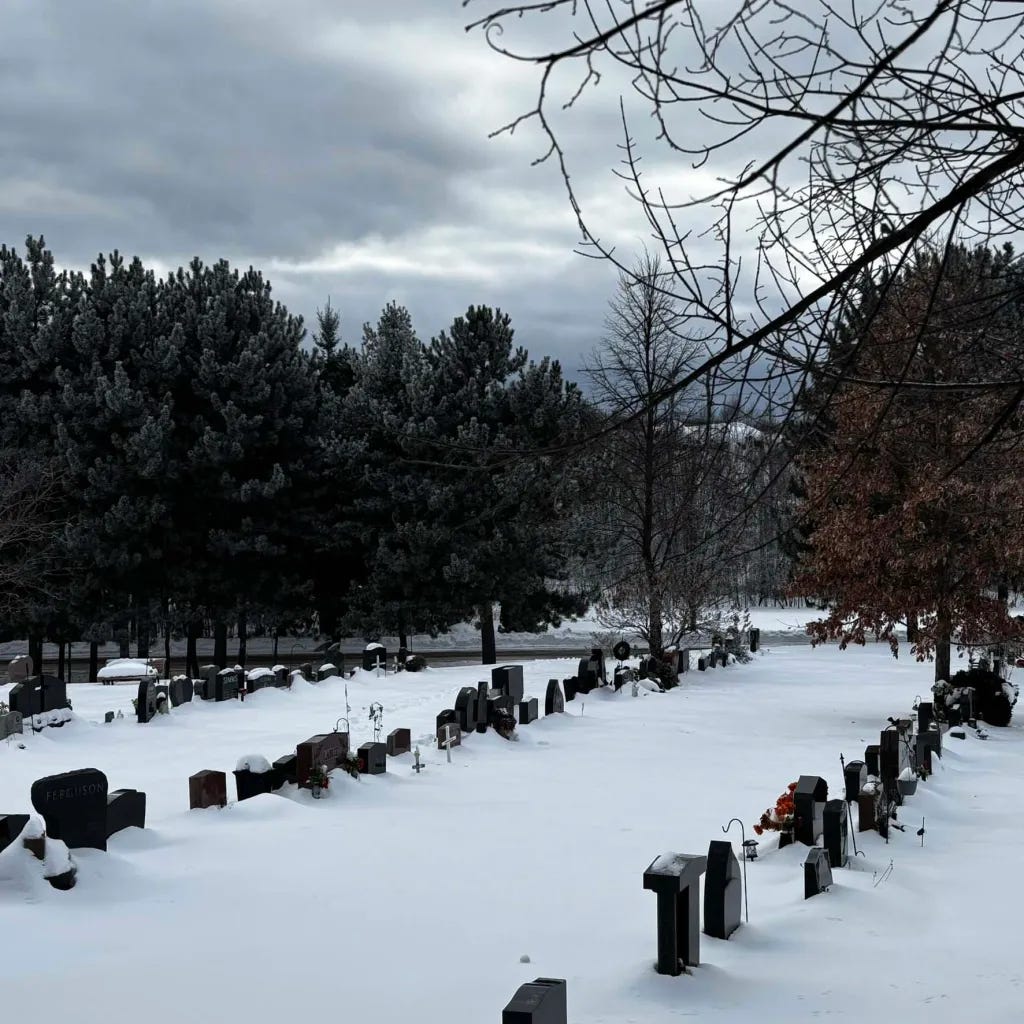
The Christmas before Ba’s accident
He handed her the burial deed on Christmas Day like he was passing the salt (and pepper).
No warning, no explanation — just slid the envelope across the table between a half-eaten crumb cake and the dregs of coffee. Another Christmas surprise from Dad.
“We won’t need it,” he said, as casually as if he were talking about old Tupperware. “We’re being buried in Sanibel.”
Kara was already in the kitchen, loading the dishwasher. Why wasn’t she hearing this? Why wasn’t she part of it?
The envelope sat in front of her, thin but heavy. One plot. Next to her mother. And the baby.
It had the same quiet finality as every other disappearance — the way Missy had, the way memory always did in this family.
“Maybe you want it,” he added. “Or Paul. If he even remembers.”
That was it. No mention of what happened on that hill. No mention of snow. Just Florida sunshine, his new life, and her mother’s grave reduced to a passing thought over brunch.
She hadn’t been to the cemetery in fifteen, maybe twenty years. The last time, the grass had been knee-high, the headstone dulled with lichen — but her mother’s name was still too sharp in the granite:
Elle Joan Donovan
Born in spring
Died in winter
A second name had never been carved.
The plot had once been meant for her father. Now he and his second wife had other plans — some poetic story about the Gulf and simplicity.
“We just thought maybe you’d want it,” he’d said, “or give it to Uncle Paul. He still visits sometimes.”
The royal we.
The your mother and I that never meant her actual mother.
Or give it to Paul, half-lost to dementia now.
The whole conversation felt like a dream — bright, slow, echoing in a room that smelled like pine and cinnamon — but the envelope was solid in her hand. Heavy. Watching. Holding it felt like being formally invited to lie down next to a mother she couldn’t remember.
It wasn’t the first time she’d been handed a goodbye disguised as a gift.
It cracked something open inside her, like a door she thought had been sealed shut had just blown in with the wind.
That night, she dreamed of snow.
In the morning, the envelope was still on the table. Waiting. She thought of Uncle Paul.
It wasn’t just his memory that was slipping — it was the fear that the memories she needed most were slipping too. The ones no one else had.
She didn’t even realize she’d picked up the phone until her husband asked, “Who are you calling?”
Her thumb hovered over Uncle Paul’s name.
Paul had always been the one to talk about things when her father wouldn’t. Not often, not easily — but enough to let her know she wasn’t alone in remembering.
He’d bring it up gently: the baby should’ve had a name, he’d say. There should’ve been something on the stone.
She first heard it as a teenager, overhearing him with his mother, confused by the sharpness in his voice. She didn’t understand then — how wrong it must have felt to bury someone nameless.
Paul once said there were things about that day no one had written down. That maybe the baby had lived, if only for moments. Long enough to matter.
Maybe, she thought, nothing ever truly disappears — it just waits to be named again.
No doctor had said it. No one had confirmed it. But Paul believed it. And she’d never quite stopped wondering.
Lately, the thought of him wasn’t the distant, abstract grief it used to be. He felt closer somehow, like a shadow at the edge of her vision. She didn’t know why.
She pressed the phone to her chest, unsure whether she wanted to call.
Paul’s mind wandered these days. He might not remember the story. He might not remember her.
But the shape of it was already blooming in her chest like a bruise.
“Uncle Paul,” she told her husband.
“Do you think he’ll answer?” he asked.
She wasn’t sure if she meant the phone —
or the silence that had been waiting on the other end of it for fifty years.
You never know unless you call.
This ending was breathtaking